Click here to sign up for our free daily newsletter
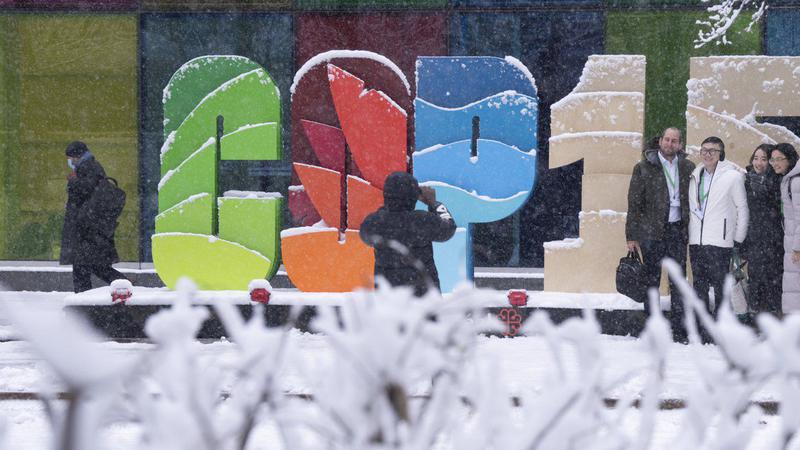
Delegates take souvenir photos during a snowfall outside the convention centre at the COP15 UN conference on biodiversity in Montreal, Friday, Dec. 16, 2022. THE CANADIAN PRESS/Paul Chiasson
COP 15

COP15 nature negotiations racing to finish line but disagreements still plentiful

Dec 17, 2022 | 2:49 PM

The draft text of a new agreement to protect nature from destructive human behaviour is still littered with disagreement with less than three days left on the official schedule of the COP15 talks in Montreal.

With one million species facing extinction this century and a majority of both land and marine environments already significantly altered by human activities, the 196 nations in the UN biodiversity convention are seeking a bold new agreement that halts further destruction of nature and seeks to restore what has already been lost.

Getting that agreement finalized is a tricky process that began four years ago and is supposed to come to fruition Monday in Montreal. But progress has been slow, particularly on the deal’s degree of ambition and how it will all get funded.

Some significant progress was made early on Saturday on one of the key parts of the framework related to how it will be implemented once parties agree to the text. Implementation specifics were lacking from the last global biodiversity agreement reached in Aichi, Japan in 2010 and that is considered one of the key reasons it failed to achieve any of its targets.

The other reason the Aichi framework failed was a lack of financing, and that is proving to be the biggest sticking point in Montreal.

Environment ministers from Rwanda and Germany spent the last two days trying to bridge a significant divide between developing and developed countries on how much money wealthy nations are offering and whether a new fund will be created to flow that money through.

“Listening to all groups, we had the feeling that over the last 36 hours, parties flexibilized their positions, but to be honest, not to the extent that is needed,” said German environment minister Steffi Lemke.

Rwanda’s environment minister Jeanne d’Arc Mujawamariya said Saturday the parties do seem to agree that developed countries need to commit to the equivalent of C$275 billion a year by 2030 from all sources, including government funds and private-sector contributions.

That’s $100 billion more at least than what the U.S.-based Nature Conservancy estimated was spent on nature conservation in 2019.

Jennifer Morris, the Conservancy’s CEO, said about US$6 billion in new public funds have been pledged in the last 18 months to protect biodiversity, which she called a significant “down payment” towards saving nature.

In the last few days developed nations have been trying hard to prove their commitment to the financing. Canada, for example, added another $255 million to its offerings on Friday, bringing its total commitment in the coming five years to more than $1.5 billion.

But developed countries, including Canada, have warned they cannot fill the entire gap on their own and accuse developing countries of making demands that simply can’t be met.

“Some of the numbers that have been mentioned are unrealistic,” said Katrin Schneeberger, director of Switzerland’s Federal Office for the Environment, during Saturday’s plenary session.

“Focusing on unrealistic and unfeasible elements will not bring us forward.”

But more than the amount of money on offer, the disagreement holding back progress on a final text is whether or not to send the money via a brand new global biodiversity fund.

The European Commission and some of its member states have been adamant that the existing Global Environment Fund is the best choice, arguing creating a new fund would take years.

Developing countries believe a new, dedicated biodiversity fund is the only way forward because the GEF, as the existing fund is mostly referred to, is bulky, inefficient and has many demands.

Lemke said there is the potential for a compromise proposed by Colombia to create a dedicated biodiversity fund within the GEF, but that has not yet been agreed to.

The other contentious target in the draft framework to conserve 30 per cent of the world’s land and marine areas by 2030 is also not finalized though some progress was made in recent days.

Egyptian environment minister Yasmine Fouad and Canada’s environment minister Steven Guilbeault were dispatched on Wednesday to make progress on that target, which is among the most critical to the goal of halting biodiversity loss and beginning to restore what has been lost by the end of this decade.

Fouad told the plenary there are some recommendations to move forward but hasn’t been specific about what those are.

Guilbeault and European ministers have been clear that increasing financing has to be met by co-operation from developing countries to meet the ambition of the 30 by 30 target.

Some developing countries worry about a loss of control or use of their natural resources if that much land is conserved, while Indigenous communities fear being forced off their own land which they have worked for centuries to protect.

Guilbeault asked the COP15 delegates Saturday to actively ensure a real, ambitious agreement is achieved, similar to how ministers gathered in Paris in 2015 came together to make a “bold agreement.”

“We did this in Paris, we can do it here in Montreal,” he said. “The entire world is watching. We have the power to change the course of history. Let’s give nature the Paris moment it deserves.”

This report by The Canadian Press was first published Dec. 17, 2022.