Click here to sign up for our free daily newsletter
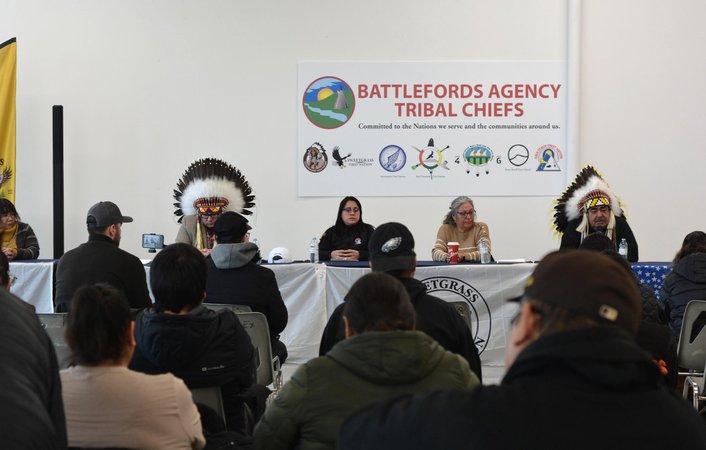
Chiefs with the Battlefords Agency Tribal Chiefs speak during a press conference in North Battleford on Monday, Dec. 1, 2025, where leaders raised concerns about rising violence, addictions and slow RCMP response times in their communities. (Photo/battlefordsNOW)
PUBLIC SAFETY

‘This is not an Indian problem. This is a social problem,’ BATC chief says as policing concerns escalate

Dec 1, 2025 | 5:19 PM

Chiefs with the Battlefords Agency Tribal Chiefs (BATC) say shootings, gang activity, drug trafficking and delayed RCMP response times have created a public-safety crisis in their communities, and they are urging federal and provincial officials to meet with them and address what they describe as systemic failures in policing and justice.

BATC represents seven First Nations in Treaty 6 territory. Leaders at a press conference Monday said escalating violence, unresolved crimes, addictions pressures and jurisdictional gaps are overwhelming their nations and leaving families without reliable police protection.

Mosquito Grizzly Bear’s Head Lean Man Chief Tanya Stone said gang-related incidents have intensified, including recent incidents that have shaken nearby communities.

“We recently had shootings,” she said, adding that residents “are well aware of who is responsible for the gang activity.”

She said RCMP shortages continue to limit response capacity across the region and her nation has already spent significant resources on security.

“We have committed millions of dollars of our own source revenue and security to the point where we cannot continue that because we need to utilize those resources elsewhere,” she said.

She said federal and provincial governments must engage directly with First Nations.

“We do need Canada, and we do need the province at the table to address this very serious issue. This is not an Indian problem. This is a social problem that’s affecting all of us.”

Attempts to advance First Nations policing have also stalled, Stone said.

A memorandum of understanding signed more than two years ago with Onion Lake Cree Nation, Little Pine First Nation and Poundmaker Cree Nation has seen “no movement in the area of tribal policing,” she said, adding that ongoing discussions have not resulted in progress.

“It’s not a priority, and it’s really unfortunate. It’s impacting our communities.”

Sweetgrass Chief Lorie Whitecalf said RCMP delays are leaving communities at risk. She described a recent emergency where officers took “over 45 minutes” to arrive.

“It was a life threatening situation,” she said, noting nurses were called to assist the victim until police reached the scene.

Whitecalf said Sweetgrass’ former community tripartite policing agreement expired this year, and that attempts to negotiate a new one with the province and RCMP have produced no results.

She said First Nations are repeatedly redirected between governments when seeking public-safety support.

“So we’re just running in a circle waiting for an answer,” she said.

A representative from Saulteaux First Nation, Alexis Christensen, said addiction, trauma and limited treatment access are compounding the crisis. She said detox and rehab spaces across Saskatchewan are often full, and that frontline workers are stretched thin in homes affected by violence and substance use.

She said meaningful solutions require all agencies involved in enforcement, justice and health to meet directly with First Nations.

“What point are we at the table? When is the meeting and where?” she asked.

Leaders emphasized that while they maintain a strong relationship with the local RCMP inspector, officers remain overextended across a wide region. Chiefs noted that members are often dispatched from neighbouring communities, contributing to slow response times and leaving nations without timely support.

“All of us Chiefs have really good relationships with the RCMP, but we recognize that they’re overworked, they’re short-staffed, and this is a concern,” Stone said.

The chiefs are calling for a government-to-government meeting with federal and provincial ministers, health authorities and the RCMP to develop concrete plans for policing and addictions support.

The province

In a statement, the Saskatchewan government said it recognizes the concerns raised by BATC and noted that communities across the province are experiencing increased pressure on police services and the impacts of addictions.

The province said it remains committed to working with First Nations leadership and the RCMP, “advocating for additional RCMP resources across the province, and advancing First Nations and Inuit policing.”

It said a $3-million pilot project with the federal government is adding Community Safety Officers to 10 First Nations, and that “early results” are showing a positive impact on safety and well-being, though the officers are not a standalone policing solution.

The province also said the Saskatchewan Marshals Service will complement existing policing services but is “not intended to replace existing services nor act as a standalone police service.”

On addictions, the government said it is expanding treatment capacity under its Action Plan for Mental Health and Addictions, including 281 of 500 planned new treatment spaces now open at sites such as Poundmaker’s Lodge in North Battleford, Onion Lake Cree Nation and Muskwa Lake Wellness Camp near Pinehouse. The province said the upcoming budget adds $1 million for addictions-medicine supports, including a new Virtual Access to Addictions Medicine program.

The RCMP

In a separate statement, the Saskatchewan RCMP said it appreciated BATC acknowledging the work of frontline officers and confirmed that staffing shortages and rising call volumes have strained police resources.

The RCMP said recruiting challenges have contributed to vacancies across the province and noted that calls for service in its jurisdiction have “rose 45 per cent over the last 10 years,” while violent crime has also increased 45 per cent over the same period and “violent firearm offences have tripled.”

The RCMP said many of the concerns raised by BATC reflect broader social issues across Saskatchewan. “We are not going to police our way out of them,” the statement said, adding the organization welcomes collaboration between communities and all levels of government on “real and meaningful solutions and change.”

“In the meantime, our police officers and staff will continue working hard to keep these communities safe. We will continue to respond to all calls for service, prioritizing – as we do everywhere – those with the most urgent risk to public safety.”

Public Safety Canada has also been contacted for comment, and battlefordsNOW is awaiting a response.

cjnbnews@pattisonmedia.com