Click here to sign up for our free daily newsletter
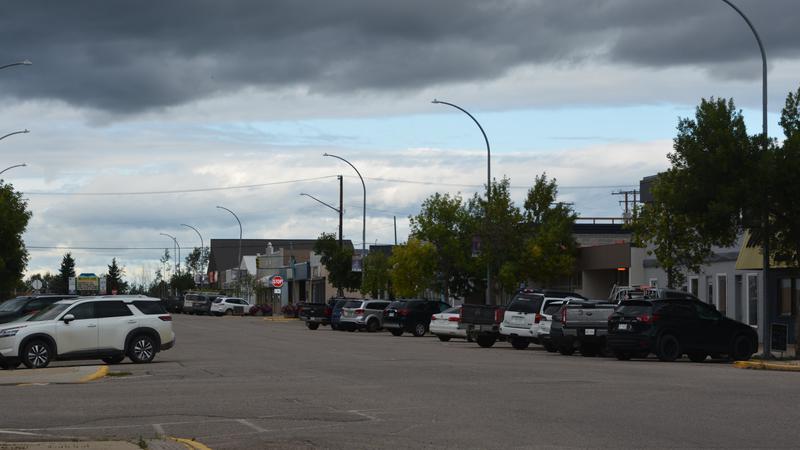
The downtown area of Meadow Lake. (file photo/meadowlakeNOW staff)
MUNICIPAL MATTERS

What Meadow Lake’s new zoning rules mean for downtown parking and solar panels

Jan 14, 2026 | 4:42 PM

If you own a business downtown, are thinking about installing solar panels, or have wondered why some developments seem bogged down by paperwork, Meadow Lake city council’s latest zoning changes could affect you.

Council approved a comprehensive zoning bylaw amendment Monday that city administration says is meant to better reflect how Meadow Lake actually functions – particularly in its downtown and mixed-use areas – while removing rules that no longer make practical sense.

The changes, adopted through Zoning Amendment Bylaw 10/2025, affect parking requirements, land-use definitions and how solar energy systems are regulated.

Downtown parking rules loosened

One of the most immediate changes residents and business owners may notice involves downtown parking.

Under the amended bylaw, minimum parking space requirements have been removed in the city’s Mixed Use Centre (MU1) and Urban Commercial (C2) zones.

That means new developments and renovations in those areas will no longer be required to meet fixed parking formulas tied to building size or staffing levels.

Administration told council those formulas often do not reflect reality, particularly downtown, where many businesses rely on shared, on-street or off-site parking and where parking needs can change over time.

City officials stressed the change does not mean parking is no longer required. Property owners remain responsible for ensuring there is adequate parking for employees and customers — the bylaw simply no longer dictates a specific number of stalls.

“Property owners will continue to be responsible for ensuring that adequate parking exists to accommodate both employees and customers,” administration noted in its report.

The amendment also updates parking screening rules. In the past, parking areas accessed from rear lanes were often required to be fenced or landscaped even when screening was impractical.

The revised rules provide more flexibility for lane-accessed parking while still allowing the development officer to require changes where safety, sightlines or pedestrian movement could be affected.

Solar panels easier to approve

The amendment also changes how solar energy systems are treated under the zoning bylaw.

Rooftop solar panels are now exempt from development permits, meaning homeowners and businesses no longer need council approval to install them. Building permits are still required to address structural considerations.

Stand-alone solar panels are now classified as accessory uses and are permitted in most zoning districts, including residential, commercial and industrial areas. Depending on their size, they may still require building permits.

As part of the update, solar panels have been removed from the definition of “Alternative Energy System,” which continues to apply to other technologies such as wind turbines and geothermal systems.

“In recent years, rooftop solar panels have become more common, and are increasingly attractive to property owners wishing to reduce their electricity bills,” administration stated in its report.

“As has been previously identified by council, there is no valid reason to force these installations to go through the discretionary use approval process. Rooftop solar panels pose no foreseeable nuisance to adjacent properties.”

Clearer definitions for how land is used

Another major focus of the amendment is improving clarity around how different types of buildings and services are classified.

Administration said unclear or outdated definitions have made it harder to process development applications and contributed to delays.

“This amendment will enable various permit applications to proceed without preventable delays,” administration noted in its report.

A new definition for “Community Support Services” has been added to better describe non-profit social and welfare uses such as food programs, counselling, skill development and drop-in support. The definition explicitly does not include overnight accommodation or temporary emergency shelter.

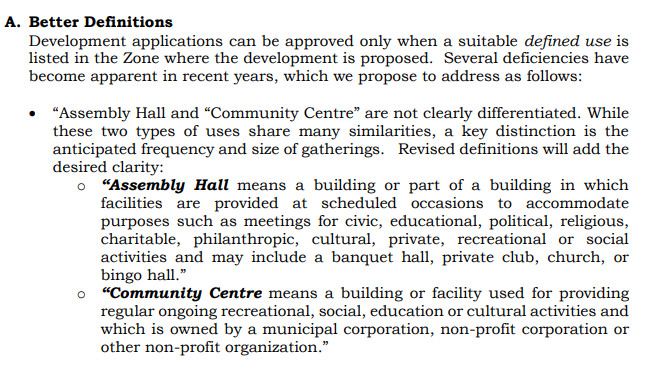
Other definitions were also refined, including those for assembly halls and community centres, to better distinguish between different types of gathering spaces based on how frequently they are used.

Updated definitions in Meadow Lake’s zoning bylaw clarify the difference between an assembly hall and a community centre as part of amendments approved by city council. (Screenshot/City of Meadow Lake)

The bylaw also updates parking definitions to recognize stand-alone parking lots, a move administration said brings existing parking arrangements into compliance with zoning rules in commercial areas.

What this means for the city

With council’s approval, the zoning changes take effect immediately.

Administration says the amendments are intended to reduce preventable delays, bring certain existing parking arrangements into compliance and make it easier for future projects to move forward in downtown commercial areas, while maintaining oversight where safety and neighbourhood compatibility are concerned.

cjnbnews@pattisonmedia.com