Click here to sign up for our free daily newsletter
Saskatchewan's Minister of Finance, Jim Reiter, March 18, 2026. (Image Credit: Lisa Schick/980 CJME)
Budget 2026-27

Budget shows more ‘cautious optimism’: government think tank, MLAs, teachers, others react to province’s spending plan

Mar 18, 2026 | 4:51 PM

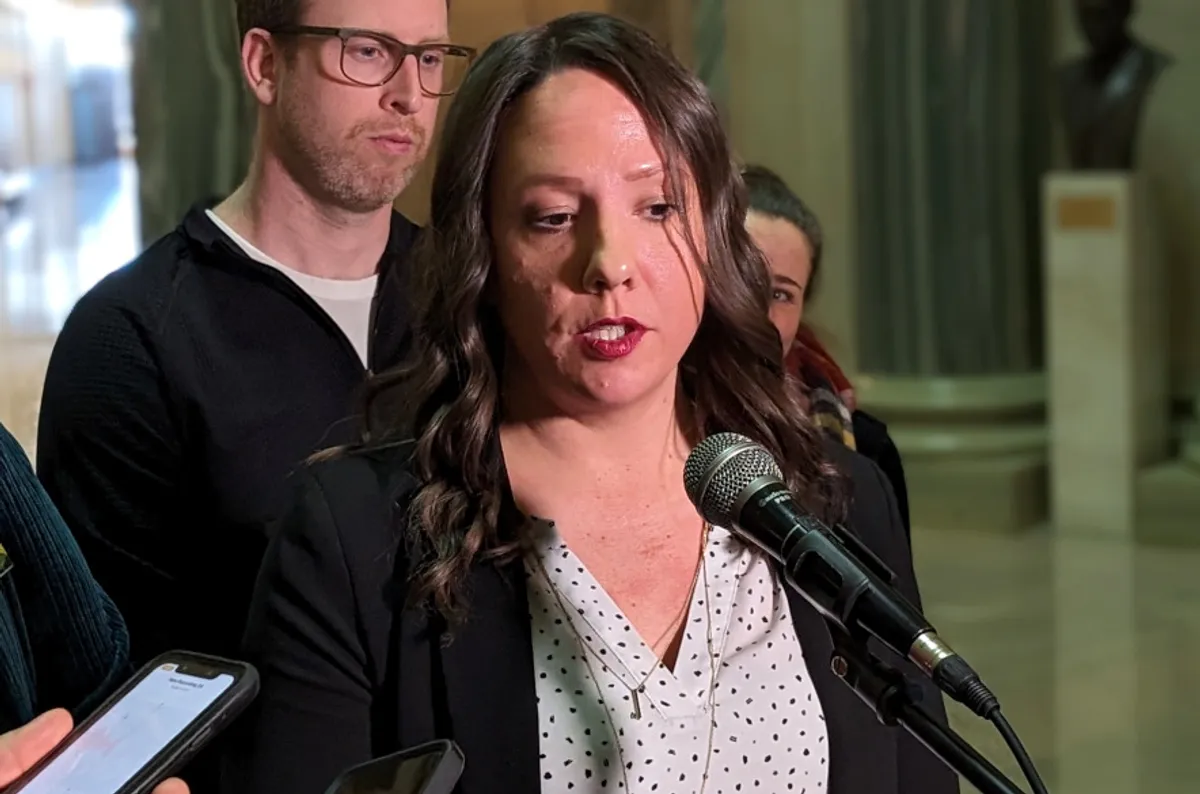
While the government touted its budgetary measures aimed at improving health care and addressing affordability, Saskatchewan NDP Leader Carla Beck said the “bad budget” will end up costing residents of the province even more.

“There isn’t a dime of gas tax relief. There are new taxes and fees on hunting, fishing and driving – even after Scott Moe promised not to raise taxes,” Beck said.

“We see child poverty rates across the province, one in 3 children, those rates are even higher in Prince Albert and the North. We’ve got the most people in this province who are reporting that they are struggling financially, having trouble paying their bills yet you have no relief in this budget for those families.”

The NDP said the budget will increase the provincial debt to “a record $43.5 billion,” adding that the province’s tax base will be “on the hook for $1.22 billion this year alone just to pay the interest on the debt – three times more than the provincial policing budget.”

Beck also criticized the added money for health care, saying it’s not enough to solve the issues in the sector.

“Not only did we only see a less than one per cent, increase over what was spent last year in health care, there is absolutely nothing in this budget to sign a contract with those healthcare workers in the province who’ve been holding the system together, who’ve been without a contract for almost 4 years.”

Beck said this raised significant concerns for retention and actually being able to staff the new facilities that are being built like Prince Albert’s new acute care tower.

The MLA for Cumberland Jordan McPhail said $36 million was cut out of the northern infrastructure dollars they use to maintain and operate highways and airports in Northern Saskatchewan.

“This is not the kind of thing we need to be seeing in Northern Saskatchewan. This is not going to help the economy thrive and after the most devastating wildfires we’ve seen in a long time,” said McPhail. “They only added a tenth of what we spent last year and every person in Northern Saskatchewan knows we need to be prepared for the next wildfire season. We need to make sure we have boots on the ground that are well-trained and our government is not taking any lessons from last year. What we are seeing is a very status quo approach to how we are going to battle back the blazes this year. “

The NDP said the budget will decrease school capital funding by 35 per cent, adding that Moe’s home community of Shellbrook got a new school while Moose Jaw and White City did not.

Saskatchewan teachers said they are deeply concerned that government has ‘abandoned its commitment to public education.’

“Budget 2026 does not address the continued challenges students face in Saskatchewan schools each day,” said Saskatchewan Teachers’ Federation (STF) President Samantha Becotte. “Despite Premier Moe constantly listing education as a top priority, he failed to deliver on his own commitments with this budget.”

The budget provides a 2.6 percent increase in operating funding for school divisions. With at least 2.5 percent needed to cover rising costs and with the government assuming enrolment of an additional 700 students, the STF said the allocation represents an inflation-adjusted decrease of $33 per student compared to the previous year.

Saskatchewan Teachers' Federation president Samantha Becotte said the government 'abandoned its commitment to public education' in this budget.
Saskatchewan Teachers’ Federation president Samantha Becotte said the government ‘abandoned its commitment to public education’ in this budget. (Image Credit: File photo/CJME)

She added students’ learning environments continue to be negatively impacted by inadequate funding, resulting in large class sizes, complex classrooms and limited access to specialized supports.

“We are preparing to enter a new round of bargaining this spring. Teachers were watching Budget 2026 as an indication of how the government may approach this round.”

Researchers at a national think tank said this year’s budget shows the government being a bit more cautious in its optimism than it has in the past.

Simon Enoch with the Canadian Centre for Policy Alternatives said the province got burned last year when it’s estimates were too high for oil. Last year, the province forecasted an average West Texas Intermediate (WTI) oil price of US$71 per barrel for the fiscal year. It actually ended up averaging around $65 per barrel.

“They’ve been much more cautious this time pricing it at $59 which is actually lower than a lot of analysts are predicting,” said Enoch. “So, they’re being extra prudent here. The price right now is a lot more than $59…whether it will stay there is completely uncertain. I thin kit’s interesting that the government perhaps has learned from its past mistakes of predictions being too optimistic when it comes to commodity price predictions.”

Speaking from the legislature in Regina, Mayor Bill Powalinsky said,“It’s always nice to come back from Regina and say we got three-quarters of a million [dollar] boost this year. It’s very helpful.”

The MLAs for Prince Albert said they’re confident in the government’s ability to reach a surplus by the year 2030. Kevin Kasun and Alana Ross said the province has never been in a position economically like we are right now.

“It is very, very positive for us in this province,” said Ross, adding she remembers a time when there was absolutely no investment from the NDP government.

“I actually left this province because there was absolutely no hope then. Now, to be here in a time when we’ve had such significant investment in our province by business, in the energy sector, agriculture is in such a positive place right now, we have trade deals with India and China…Saskatchewan has never been in this type of position before.”

Kasun, MLA for Prince Albert Carleton said Saskatchewan will pull through.

“We’ve got record investment. We have the best credit rating. I mean, just keep going. Don’t put the brakes now,” he said.


For Meadow Lake MLA Jeremy Harrison, the most significant element of the budget is support for municipalities through increased Municipal Revenue Sharing. The budget shows that amount at nearly $400 million, which is up 8.5 per cent from last year.

“There is going to be a very significant increase in funding for municipal governments,” he said, adding the funding will come as “a very, very large and significant increase in unconditional grant funding.”

Harrison said that flexibility will allow communities to decide how best to use the money.

“What it’s going to allow communities to do is either invest in infrastructure, invest in services. These are really, really important parts of protecting what we have built here in Saskatchewan and our municipal governments have been really just great partners for the province.”

He also pointed to public safety as a key focus, highlighting new investments in policing. He said the goal is “to make sure that we have the law enforcement resources on the streets.”

He described the plan in simple terms.

“We’re protecting Saskatchewan.”

The Canadian Taxpayers Federation said the province is not protecting the wallets of Saskatchewan residents. They’re calling on the government to find savings and stop borrowing money.

“Premier Scott Moe more than doubled the provincial debt and this budget borrows billions of dollars more,” said Gage Haubrich, CTF Prairie Director.

Haubrich said interest payments on the debt will cost taxpayers about one billion dollars this year, working out to about $821 per Saskatchewanian

“This budget is infuriating for taxpayers because the government couldn’t be bothered to find savings anywhere and it’s spending more per person than the big spending B.C. NDP,” Haubrich said. “The government needs to get spending under control. Saskatchewan taxpayers can’t afford to keep paying the bills for the government’s irresponsible borrowing.”

 —

panews@pattisonmedia.com