Click here to sign up for our free daily newsletter
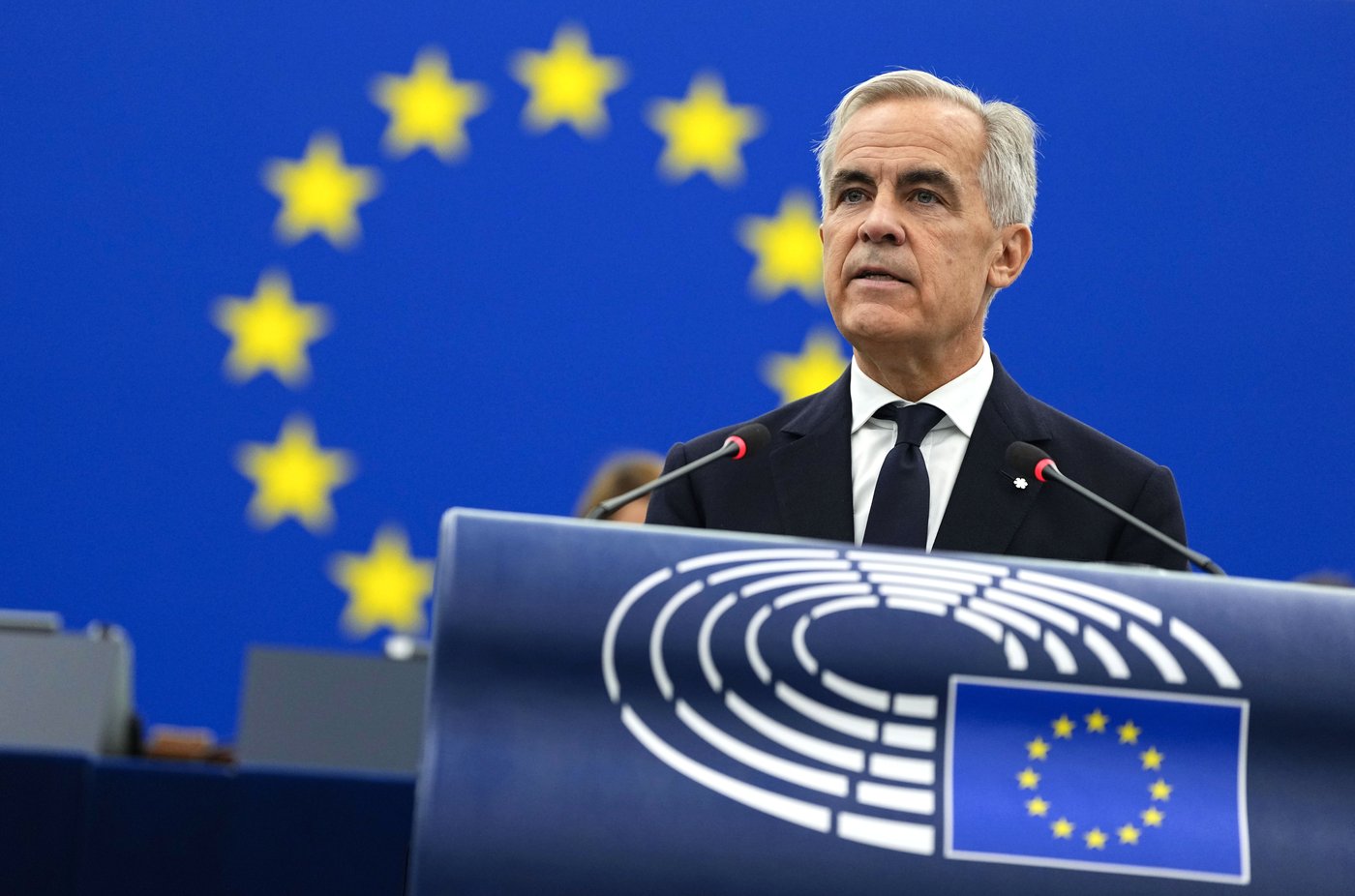
Prime Minister Mark Carney addresses the European Parliament in Strasbourg, France, on Thursday, Sept. 17, 2026. THE CANADIAN PRESS/Justin Tang

More than two in three Canadians back EU associate membership: poll

Sep 24, 2026 | 2:00 AM

OTTAWA — Canadians overwhelmingly support Canada becoming an associate member of the European Union, a new poll suggests — even though the details of that arrangement haven’t been finalized.

The online poll by Leger, conducted between Sept. 19 and Sept. 21, suggests 70 per cent of Canadians support the idea, 18 per cent are unsure and 13 per cent oppose it.

But the poll suggests Canadians draw the line at changing some laws in order to align with Europe.

In a speech to the European Parliament last week, European Commission President Ursula von der Leyen said she was opening the door to negotiating terms for Canada to become the first associate member of the European Union.


A day later, Prime Minister Mark Carney told the EU Parliament that Canada welcomes the goal, though exactly what that entails is still to be determined.

“We welcome this ambition — polling shows an overwhelming majority of
Canadians support much closer ties,” Carney said in his speech.

The Leger poll appears to support Carney’s assertion.

Support was strongest among seniors across the country with nearly 80 per cent support. Respondents in Quebec and Ontario also seem to be on board, with more than 70 per cent of respondents in those provinces saying they support it.

Andrew Enns, Leger’s executive vice-president for Central Canada, said other of his firm’s polls have shown seniors are preoccupied with concerns about the United States, and react strongly to threats and comments by U.S. President Donald Trump regarding Canadian sovereignty.

“I think you see that age cohort really sees this as an opportunity to put proof to the conversation around diversifying Canada’s reliance and shifting it away from America,” Enns told The Canadian Press.

But the poll suggested Manitobans and people in Saskatchewan aren’t as keen on the idea — or don’t know enough about it.

More than a quarter of respondents in those provinces said they opposed joining the EU as an associate member, while another quarter didn’t know or were unsure.

Enns said the lack of support in Manitoba and Saskatchewan may be a byproduct of Canadians in those provinces having not travelled to Europe as much as people in Ontario or Quebec.

“I’m not sure if there’s higher opposition in those provinces as opposed to there’s a bit more of a question around whether or not this is really a good thing,” Enns said.

He said there may also be some hesitancy in those provinces with respect to increasing trade with Europe.

“Those provinces, a large portion of their exports are agricultural exports. And Canada has had a bit of a bumpy history in terms of its agricultural exports into the European Union,” Enns said.

“I remember back in the days when genetically modified crops were quite popular in North America, Europe was creating some barriers to that. So there could be a bit of a lingering recall that trade and export into the European Union can still be a bit challenging, and maybe there’s a little bit of the hangover from that effect.”

Carney said in his speech that Canada and Europe should have deeper ties on critical minerals, defence, artificial intelligence and energy security.

He also said the two should move forward in allowing youth to live, work and study on either side of the Atlantic, and create an integrated market for financial services.

Canadian officials have stressed that a specific name for any enhanced partnership with Europe still needs to be determined — whether it be an associate member, or an “alliance of the future.” More details on the plan are expected at the Canada-EU summit in Montreal next month.

The Leger poll asked its 1,533 respondents whether certain aspects of a potential agreement would make them more or less likely to support Canada developing deeper ties with Europe.

The prospects of giving Canadian businesses greater access to European markets, and vice versa, saw greater than 60 per cent support across all provinces — except for Manitoba and Saskatchewan which only saw 44 per cent support.

More collaboration on defence, and more flexibility to live, work, and travel in Europe — and vice versa — also saw greater than 50 per cent support overall.

Where Canadians seem to draw the line is if Canada would need to change some of its laws and regulations to align with the European Union.

Only 25 per cent of respondents said such a move would make them more likely to support a deal with the EU, with 30 per cent saying it would make them less likely to support it.

The polling industry’s professional body, the Canadian Research Insights Council, says online surveys cannot be assigned a margin of error because they do not randomly sample the population.

This report by The Canadian Press was first published Sept. 24, 2026.

Nick Murray, The Canadian Press