Click here to sign up for our free daily newsletter
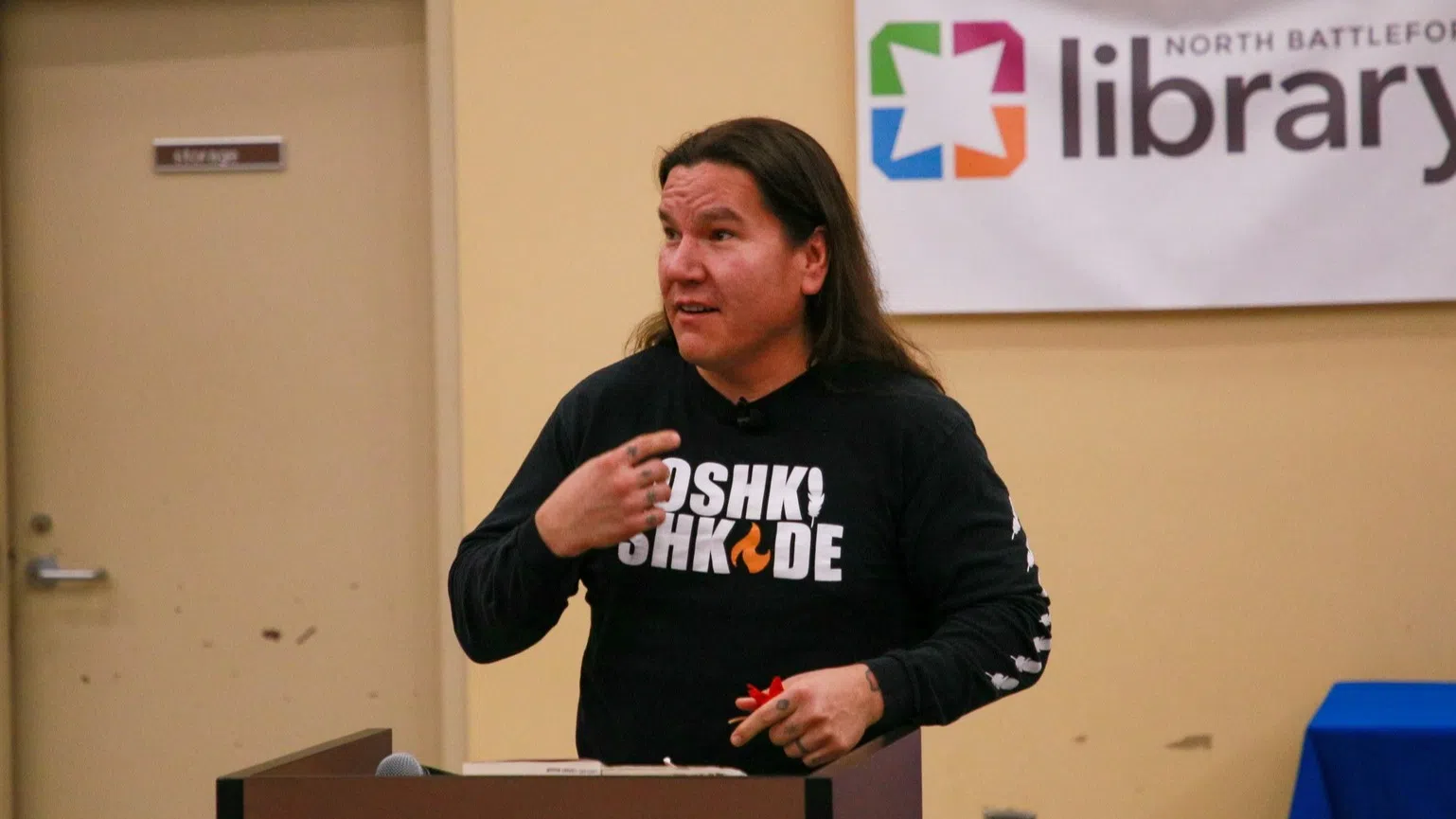
Waubgeshig Rice presenting in North Battleford as part of Indigenous Storytelling Month. (Image Credit: Atoskewin Success Centre/ Facebook)
INDIGENOUS STORYTELLING MONTH

Rooted in culture, Waubgeshig Rice brings stories of Indigenous identity to Saskatchewan

Feb 27, 2026 | 10:21 AM

When Waubgeshig Rice steps up to speak, he does so with a purpose: to represent his culture and the Wasauksing First Nation community that shaped him into the Anishinaabe author he is today.

During an Indigenous storytelling event in North Battleford this week, Rice reflected on his upbringing along the eastern shore of Ontario’s Georgian Bay, describing a childhood deeply rooted in community and cultural celebration.

“Growing up in Wasauksing in the 1980s and ’90s was essentially life-changing for me. It’s what got me on the path to being a writer and a storyteller today,” Rice explained.

Throughout his elementary school years, he developed a strong sense of identity and pride as an Anishinaabe person, with storytelling woven into everyday life.


“If we were sitting in class and we’re doing math, an Elder walks in the door. He says, ‘Oh, I want to come in and tell the kids a story.’ That’s always what would be a priority,” said Rice.

That immersive, hands-on storytelling began to fade when he left the community to attend high school in Parry Sound. Instead of Elders sharing oral histories, he found himself sitting silently in classrooms with books, longing for the stories passed down through generations.

Although he looked forward to English class each day, Rice said it wasn’t the curriculum that inspired him to become an author. Instead, it was his aunt who taught at Wasauksing First Nation’s elementary school.

“One time we had this family function, and I was just sitting with my auntie there. She’s like, ‘Hey Waub, how’s that school going?’,” he recalled.

He told her about his good grades and his love of reading. When she asked which authors he enjoyed, he listed Shakespeare, W.O. Mitchell, and Sir William Golding.

“And white dude after white dude after white dude after white dude,” Rice laughed.

What felt like an ordinary conversation to him clearly resonated differently with his aunt.

“After that, for my birthday or for Christmas or for just any other random occasion, she started giving me books by Indigenous authors,” he said.

Those books included stories that reflected experiences closer to his own, and inspired him to begin writing fiction rooted in the realities of growing up in his community.

Moon of the Crusted Snow

Rice’s third novel, released in 2018, was heavily influenced by his experience during the Northeast Blackout of 2003, a massive power outage that left nearly 50 million people without electricity for two days.

The day the blackout hit, Rice was house-sitting with his two younger brothers.

Hour after hour passed without power.

“So me and my brothers, right away, were like, this must be the big one. This must be the end of the world,” he said.

About a year later, he found himself discussing the event with his grandmother.

“She’s like, ‘Oh, end of the world? That wasn’t the end of the world,’” Rice recalled.

His grandmother spoke about deeper struggles like community hardships and the historic trauma endured by their ancestors.

“And she’s like, ‘That’s what the end of the world is. Our people have gone through that so many times over the course of our issues since settlers came and took over our land,’” he added.

That conversation became a defining moment. During his North Battleford presentation, Rice shared a passage from the novel inspired directly by that exchange.

Indigenous Storytelling Month

For Rice, Indigenous Storytelling Month is about more than sharing narratives. It’s about creating space for authentic voices and building understanding for the future.

“I think there’s still a lot of stories to tell, and there are still a lot of experiences to learn, both amongst Indigenous and non-Indigenous people,” he said.

The author’s presentation was made possible through a donation to the North Battleford Public Library from Battlefords Agency Tribal Chiefs (BATC).

Tracy Benson, CDC general manager for BATC, said the contribution helps strengthen community connections.

“In our area, North Battleford, we are surrounded by quite a few nations and stories for Aboriginal Storytelling Month,” said Benson. “It gives the community an opportunity to gather, reflect, and honor those voices.”

Indigenous Storytelling Month

For Rice, Indigenous Storytelling Month is about more than sharing narratives. It’s about creating space for authentic voices and building understanding for the future.

“I think there’s still a lot of stories to tell, and there are still a lot of experiences to learn, both amongst Indigenous and non-Indigenous people,” he said.

The author’s presentation was made possible through a donation to the North Battleford Public Library from Battlefords Agency Tribal Chiefs (BATC).

Tracy Benson, CDC general manager for BATC, said the contribution helps strengthen community connections.

“In our area, North Battleford, we are surrounded by quite a few nations and stories for Aboriginal Storytelling Month,” said Benson. “It gives the community an opportunity to gather, reflect, and honor those voices.”

 —

Alyssa.rudolph@pattisonmedia.com