Click here to sign up for our free daily newsletter
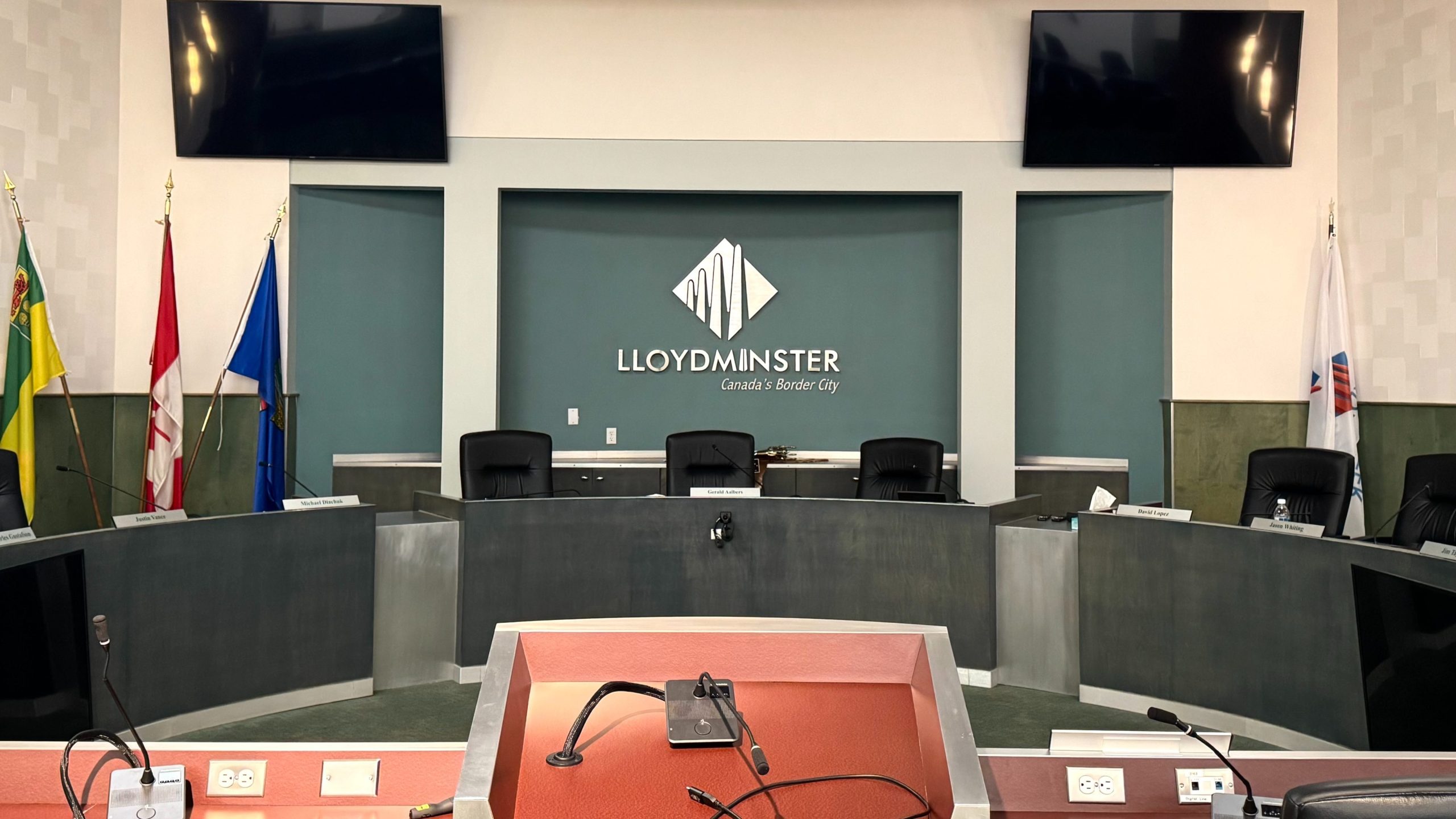
The council chamber of the City of Lloydminster. (Image Credit: Kenneth Cheung/battlefordsNOW)
municipal matters

Lloydminster proposes 3.75% municipal tax hike, higher infrastructure levy

Nov 5, 2026 | 4:49 PM

Lloydminster’s proposed 2027 budget would add $120 to the annual property tax bill for a $350,000 home and identifies $42.2 million in unfunded capital projects.

The first draft includes a 3.75 per cent municipal tax-rate increase and an increase in the infrastructure tax rate to 1.5 per cent from one per cent. It also assumes assessment growth of 3.5 per cent.

Under the city’s estimates, annual property taxes on a $350,000 home would rise to $3,809 from $3,689, an increase of $10 a month.

For a $250,000 home, the proposed increase would be $84 annually, or $7 a month. Taxes on a $500,000 home would increase by $168 annually, or $14 a month. The city’s illustrations leave education and seamless tax amounts unchanged.

A non-residential property valued at $1 million would face an additional $588 annually, bringing its illustrated tax bill to $18,507.

The draft proposes an operating budget of approximately $126 million, compared with $121.4 million in 2026, and a $30.5-million capital budget. The operating plan projects a $36,891 surplus after reserve transfers.

In a written message accompanying the draft, city manager Dion Pollard described the proposal as a “hold the line” approach focused on maintaining services and financial sustainability.

“It means making thoughtful choices, being realistic about what we can afford, and ensuring we’re positioning the organization to remain financially sustainable.”

The presentation identifies inflation, negotiated collective agreement adjustments, increased reserve contributions and reduced use of existing reserves for current spending as pressures on the property tax requirement. Grants, user fees, franchise fees, other revenues and lower debt payments would offset some of those pressures.

Salaries, wages and benefits would total $48.9 million, up from $46.7 million in the 2026 budget.

The city proposes contributing $18.1 million to reserves, compared with $16.6 million in 2026. Reserve funding used for operations would fall to approximately $1.6 million from $4.3 million.

Total reserves, including offsite funds, are projected to finish 2027 at $48.7 million, compared with the $51.4 million forecast for the end of 2026.

The capital proposal includes $4.8 million for municipal and financial software replacement, financed through borrowing.

Other projects with funding identified include $3.5 million for construction on 52 Street between 67 Avenue and 75 Avenue, $3 million for the water and sewer replacement program and $2.5 million for watermain improvements involving the 49 Avenue bypass.

Recreation spending includes $1.265 million for roof repairs at Servus Sports Centre and $900,000 for the second phase of the Cenovus Energy Hub parking lot.

Funding sources for the capital budget include reserves, grants, offsite funds and borrowing.

However, the draft lists more capital work without funding than with it. Unfunded projects total $42.2 million for 2027, including $17.1 million in environmental services and $10.9 million in transportation.

Among the unfunded items are $8.5 million for the North East Phase 1 land development project, $7 million for stormwater work at 50 Avenue and 36 Street, and $5 million for the central business district wastewater replacement program.

Pollard said in his message that the city’s infrastructure needs exceed what it can fund in a single year.

“There are substantial unfunded capital requirements across several areas, and addressing those will require continued planning, reserve contributions, external funding opportunities and Council prioritization.”

Across the 2027-36 capital plan, the city lists approximately $215.4 million in funded projects and $407 million in unfunded projects. The presentation describes the 2028-30 projections as preliminary and the 2031-36 outlook as exploratory.

Residents would also see changes to utility charges.

The draft includes three per cent increases in water and stormwater rates and a five per cent increase in landfill rates. Residential waste and recycling charges would fall nine per cent, with the presentation noting that recycling responsibilities have shifted to producers.

For a household using 11 cubic metres of water a month, the city’s example shows a monthly bill rising to $123 from $121, an increase of $24 annually.

A household using five cubic metres monthly would see its illustrated bill remain at $94. At 20 cubic metres, the monthly bill would rise to $166 from $163. Those examples assume a lot of up to 2,000 square metres and a five-eighths-of-an-inch water meter.

The draft also budgets for anticipated demand following the transition from the Senior Taxi Program to the Transit Assistance Program. The net operating cost of social programs and services would rise 16.4 per cent to approximately $1.18 million, before reserve transfers.

Community funding would total approximately $2.16 million, up from $2.03 million in 2026. The library’s allocation would rise to approximately $1.38 million from $1.31 million.

The budget-engagement campaign ran from June 11 to Aug. 19 and gathered 468 survey responses on municipal service funding priorities.

The presentation scheduled a second draft for council’s consideration and approval Nov. 23, with Dec. 14 identified as a contingency date.

—

Kenneth.Cheung@pattisonmedia.com