Click here to sign up for our free daily newsletter
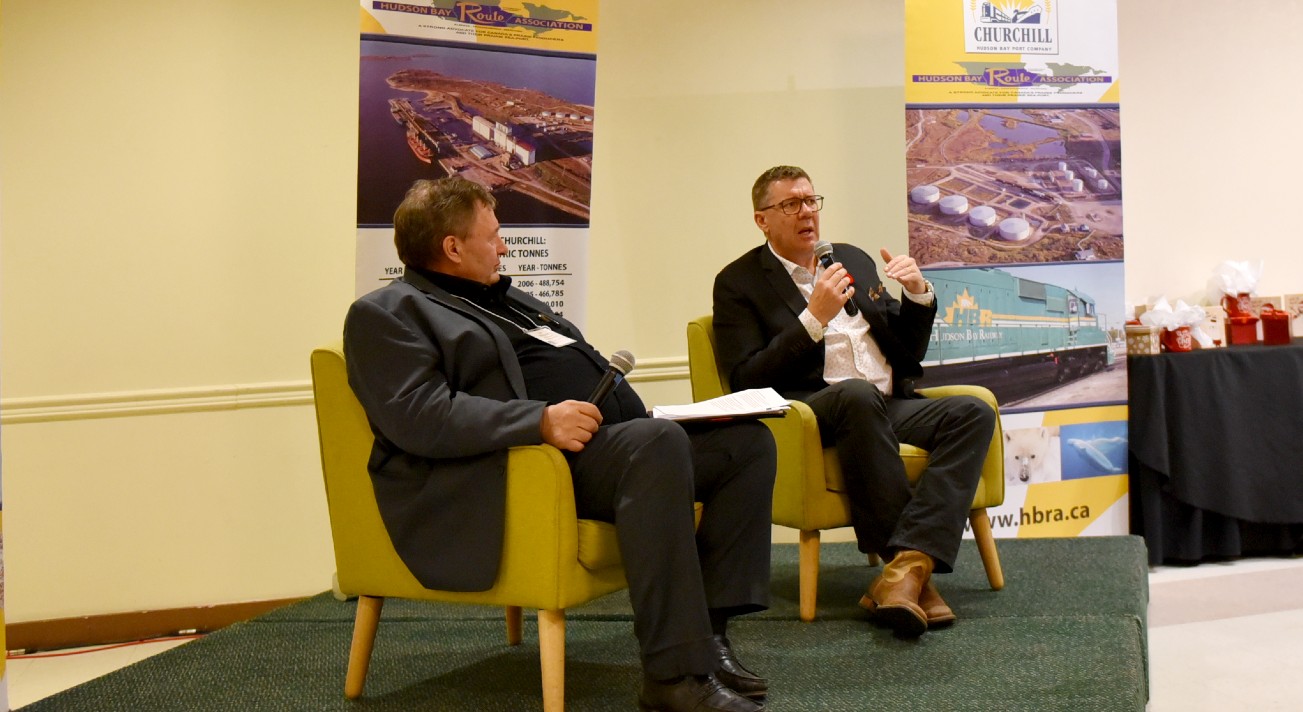
President of the Hudson Bay Route Association, Jim Berscheid (left) quizzed Premier Scott Moe about how expand shipping out of the Port of Churchill at the Coronet Hotel in Prince Albert on Friday, Nov. 6. (Image Credit: Susan McNeil/paNOW)
Business first

Making the business case, Premier Scott Moe talks about Port of Churchill expansion

Nov 6, 2026 | 1:06 PM

Saskatchewan Premier Scott Moe told a group of municipal and business leaders on Friday that once the Port of Churchill can show strong interest from business, getting related government infrastructure funding will flow more easily.  

Moe was speaking in Prince Albert at the annual meeting of the Hudson Bay Route Association (HBRA), an advocacy group that has been pushing for the expansion of a trade corridor from northeast Saskatchewan to the port in Manitoba for decades.  

Saskatchewan has been pressing for the expansion of the port, which would allow more direct and faster exports to Europe, a growing market for products like potash, but Moe said some key factors, such as ice breaking capability, need to be put in place first.  

“So this is, I think, an opportunity in the conversation around the Port of Churchill actually functionally moving forward, being led largely by the private sector, but being supported by all levels of government as we find our way to that,” he said.  

READ MORE: Grain moves through Port of Churchill

As part of his presentation, Moe had a ‘fireside chat’ with Jim Berscheid, president of the HBRA and municipal councillor for The Pas, Manitoba. 

Moe suggested several times that they keep in mind that casual conversations and questions can lead to business deals happening.  

In fact, during the chat, Moe instructed Terri Bromm, MLA for the Carrot River Valley, to create an ad hoc group that would have the purpose of bringing various interests together to help bring more businesses into the port.  

“She’ll be supported and led by Warren Keating, our Minister of Trade and Export Development, to bring together the groups that we know are looking to layer in potential investment in the Port of Churchill,” he said.  

The group would also be expected to connect with a similar group in Manitoba and jointly work with the federal government.

Moe pointed to some major developments as making the eventual expansion of the port more likely. In February, the federal, Saskatchewan and Manitoba governments announced they will invest $262.5 million to upgrade the Port of Churchill and Hudson Bay Railway, with Ottawa contributing $180 million.

“This is the time. If this port is going to be successful, it’s going to have to be larger than one industry,” he said. 

“We see the federal defence spending or investment being committed to, which will include ultimately icebreakers that could keep this port open for many more months of the year than it currently is.” 

That would mean being able to ship liquefied natural gas from Alberta, increasing the agriculture products that already ship out of Churchill and adding minerals like potash, copper or other elements that are being mined in northern Saskatchewan now.  

Some of those things are already under development or have happened.  

While Moe said that the effort needs to be led by business, the province does have a role to play when it comes to road upgrades between Nipawin and the Manitoba border, something Mayor Marlon Zacharias of the Town of Nipawin was quick to point out.  

“Highway 55 has approximately 78 kilometers that remains gravel, and that represents a huge holdback in terms of weight restrictions in the spring and in the fall, as well as major dust concerns,” he said. 

“It’s also a little more dangerous road as well in terms of just general travel because of the road conditions and how they can deteriorate so quickly throughout the seasons.” 

Zacharias said that he expects Nipawin to reach city status in the next few years, and the community is well-poised to be a major waypoint between Lloydminster and The Pas. 

He and the mayors of Lloydminster, the Town of Churchill and the city of Thompson, MB, have created a group of their own to co-ordinate their advocacy efforts.  

“What we’re working on is bringing together municipalities to create a single voice when it comes to working with provincial governments in Saskatchewan and Manitoba, as well as with the federal government to advocate for not just Highway 55, not just rail, but the Port of Churchill as a whole and getting any products we can from our province out to the port and into the global markets,” he said.  

They began meeting this past August and will make a trip to Ottawa next month to bring their ideas to some federal ministers there. 

Activity at the port has expanded significantly in the last few years, beginning with the shipment of the first load of grain in early September.  

Since then, the Arctic Gateway Group (AGG), which owns and operates the Port of Churchill and the Hudson Bay Railway in northern Manitoba, has signed an agreement with the Port of Rotterdam to work together to attract business and strengthen supply chains between the two ports.  

At the end of October, AGG signed another agreement with CentrePort Canada and DP World. CentrePort is a tri-modal dry port near Winnipeg and DP World is an Emirati multinational logistics company that specializes in cargo movements, port terminal operations and free trade zones.  

—

susan.mcneil@pattisonmedia.com