Click here to sign up for our free daily newsletter
Chris Hopkins spoke at Prince Albert Chamber of Commerce luncheon in May and gave an update on the alumina project near Tisdale. (Image Credit: Susan McNeil/paNOW)
Pre-feasibility study

CEM gets ready to show numbers on Tisdale alumina project  

Sep 10, 2026 | 2:19 PM

A potential alumina mine near Tisdale is getting ready to drill down into the numbers, showing whether the project makes economic sense or not with a pre-feasibility study.

CEO Chris Hopkins said that Canadian Energy Metals has shown they can produce high-purity and chemical-grade alumina and now have also shown they can make smelter-grade alumina.  

“We’ve confirmed the ability to produce an on-spec, smelter-grade alumina. It does not mean we are producing it. We will now go into the piloting of that and confirm the costs and whatnot,” he said. 

Alumina can be refined into aluminum by dissolving it and then applying large amounts of electricity to it.

High-grade alumina is extremely expensive and used for things such as LED lights and lithium-ion EV batteries. Smelter-grade alumina trades at about 20 per cent of the cost of the higher-purity product and is used for industrial and commercial manufacturing. 

With those products shown to be possible, Hopkins said the pre-feasibility study will serve as an advanced economic assessment. CEM plans to have the study done by year-end or early 2027. 

The pace of development is proceeding quickly, something Hopkins attributed to positive support from all three levels of government, local to federal.  

“For the first time in my life, I’m actually seeing a highly supportive federal government, provincial government and municipal governments. There is a high degree of enthusiasm for a metal like aluminum, especially as what we’ve been saying, we can mine it and process it in a way that is better than the industry standards in terms of environmental behaviour and impact. So we’ve met nothing but supportive governments,” he said.  

At the same time, CEM is working with six local First Nations and said the engagement has been positive.  

When CEM made its announcement earlier this year that it would be pursuing the Thor Project, as it has been named, Hopkins was accompanied by Premier Scott Moe, who called the discovery “of global importance.”  

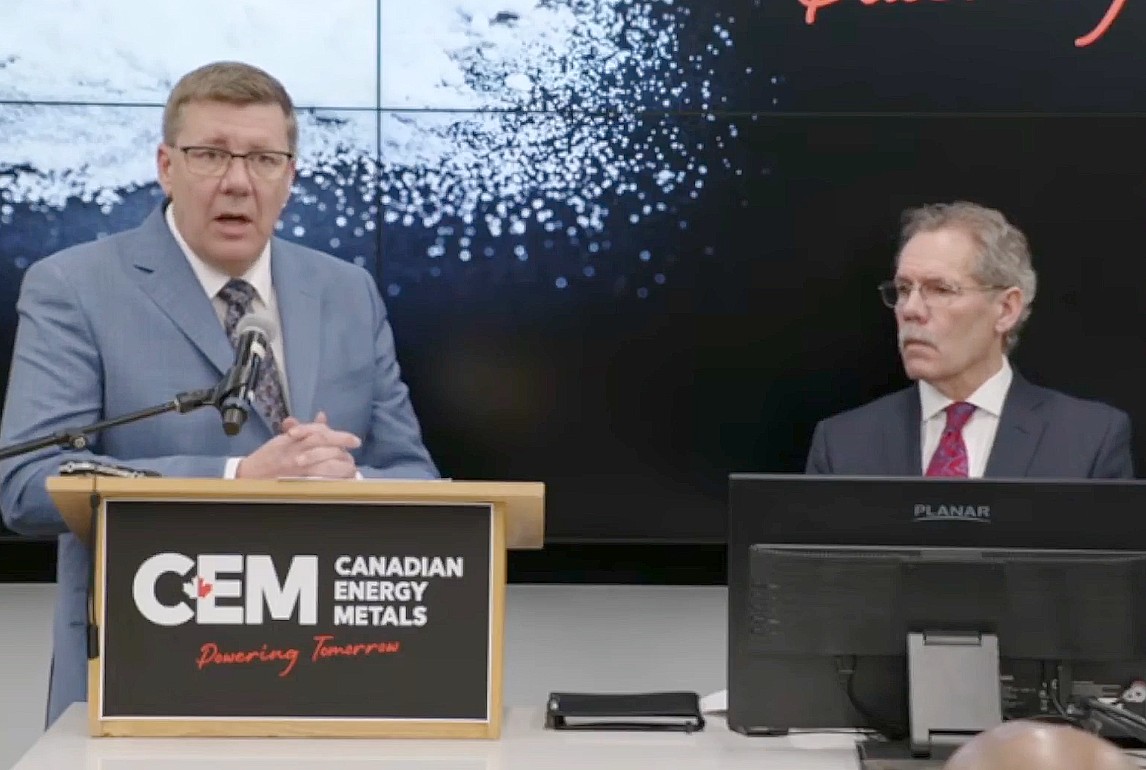
Saskatchewan Premier Scott Moe and Canadian Energy Metals CEO Christopher Hopkins spoke at a press conference Friday morning.
Saskatchewan Premier Scott Moe and Canadian Energy Metals CEO Christopher Hopkins spoke at a press conference Friday morning. (Image Credit: Screenshot/Premier Moe Facebook)

Canada is already the fourth-largest producer of aluminum in the world, but imports bauxite and other raw materials from other countries to support that production. 

Hopkins has said CEM’s process could provide a domestic source of alumina, making the project attractive to markets in Europe and Canada that are looking for lower-impact supply chains. 

Lightweight but strong, aluminum is highly valued for the production of electronic devices, aircraft and power lines, not to mention aluminum foil, appliances and spacecraft.  

Hopkins said the project is attracting attention from global investors. 

“Now we have a domestic source. That’s what we’ve accomplished at Canadian Energy Metals. So, this has attracted attention worldwide from major producers. And in fact, I’ll be leaving tomorrow for Europe to speak to companies over there,” he said.  

China is the top supplier of aluminum in the world and having the ability to control more of the supply chain in North America is important, Hopkins has stated previously.  

Despite the positivity around the Thor Project, some questions have arisen as to whether it will ever take shape.

Hopkins said he gets why people might have doubts when the project was just a prospect and the idea of a North American supply of alumina was new. He added that is why CEM used some of the most reputable firms they could find to work with.  

“We use Stantec, one of the largest engineering firms in the world, and specialists in shale and mining to do all of our geologic work and mine planning, as well as assist us with our environmental studies. Also, we’ve engaged Hatch Engineering, one of the major leaders in the aluminum sector, and they do our process engineering. So, what I would say to the doubters is all of our technical reports are available publicly.”  

The reports can be seen on SEDAR or the CEM website has a link to them.

susan.mcneil@pattisonmedia.com